


Digital AI Sales Assistant for Retail
End-to-end AI assistant automating client interactions before and after purchase. From product advice to support and warranty, the assistant improves customer satisfaction with real-time, human-like communication.
- Response time dropped from 30 minutes to under 2 minutes
- Up to 70% first line requests automated
- 11% increase in conversion rates from chat interactions
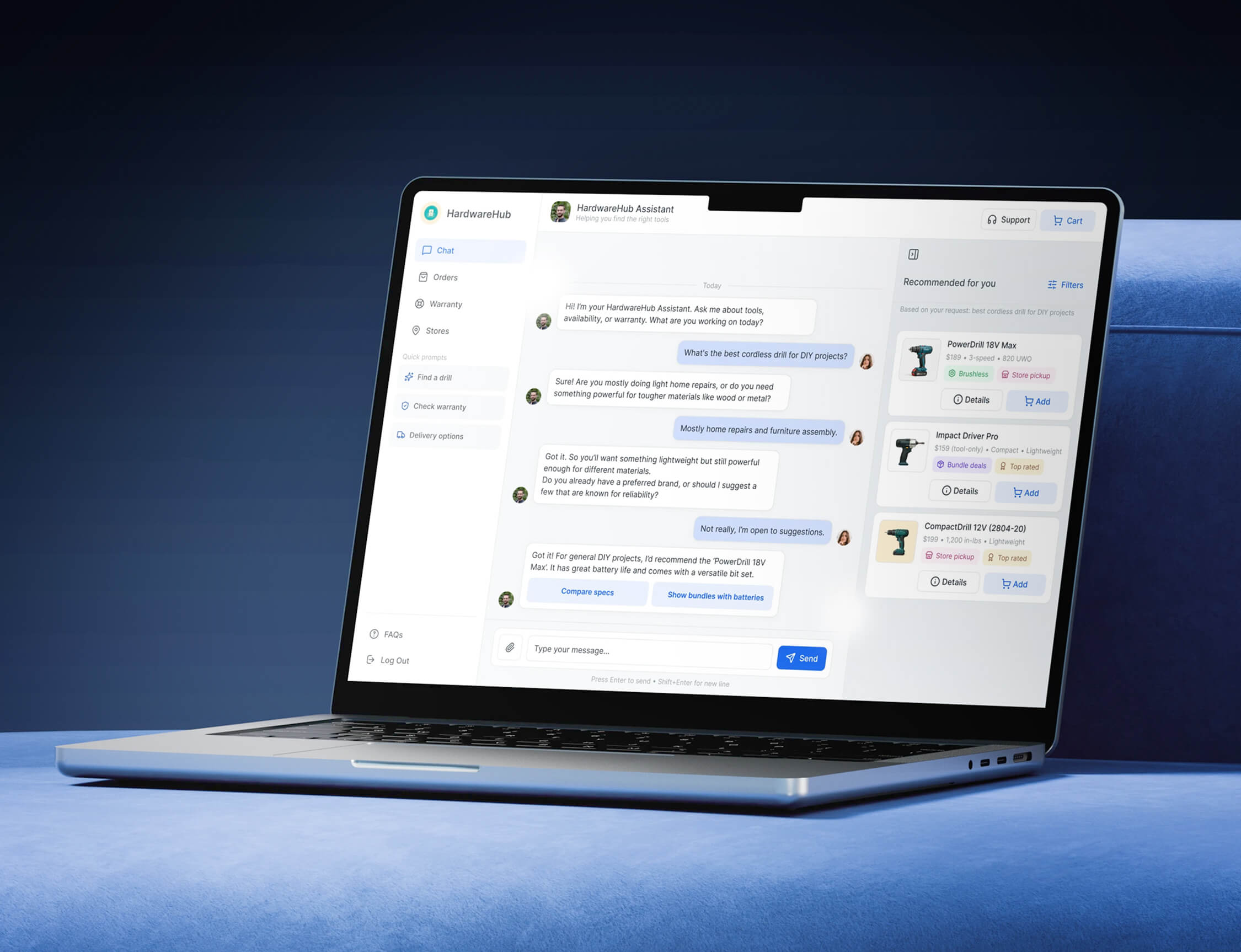
Overview
The project aimed to design and implement an AI-powered digital sales assistant for a leading hardware and tools retailer. The primary goal was to transform customer interaction, reduce dependency on contact center operators and improve the purchase experience from product discovery to post-sale support.
The product team focused on enabling instant, human-like dialogue, personalized recommendations, and automated end-to-end customer service, while integrating seamlessly with existing company’s systems.
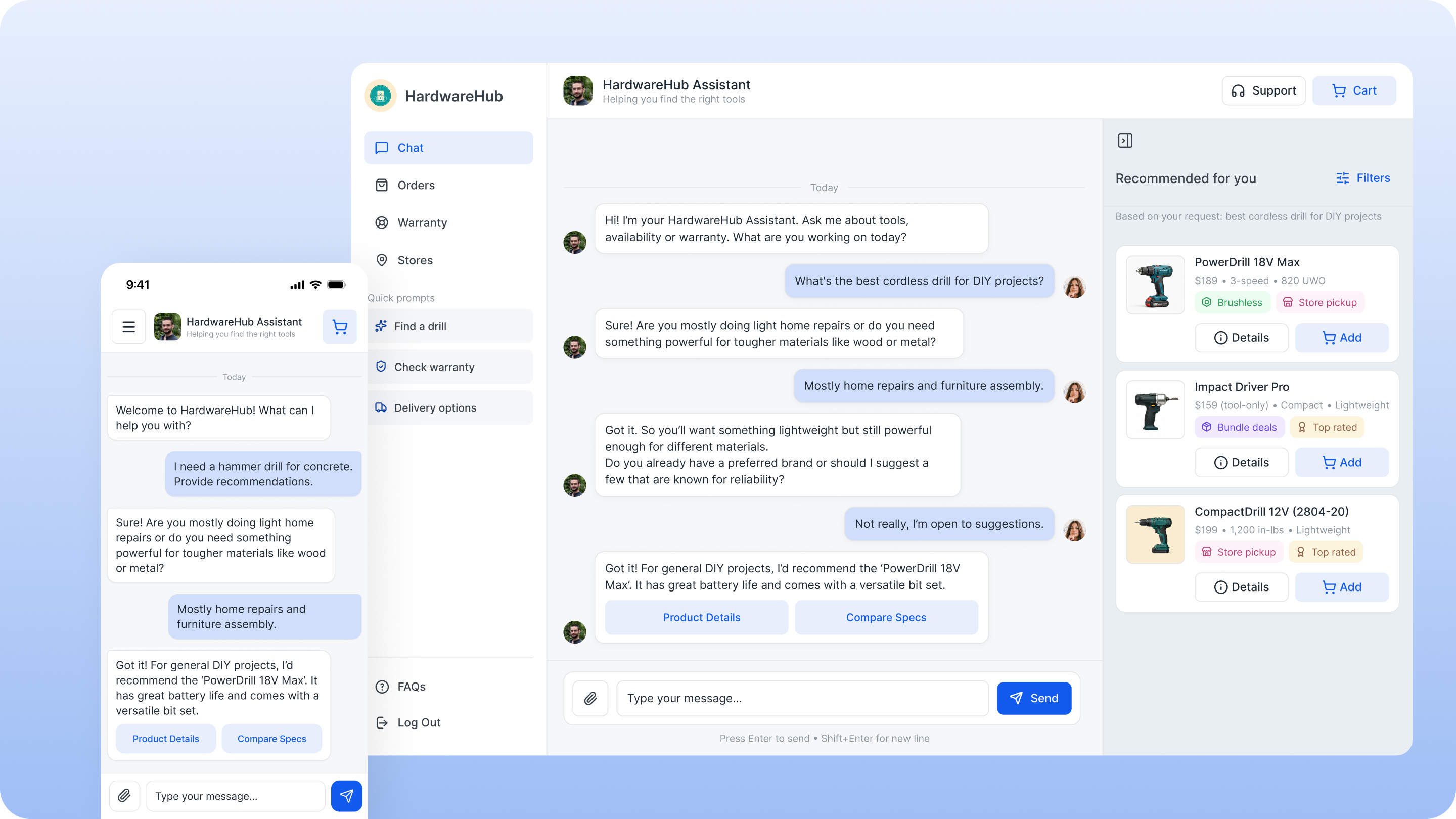
Key business objectives included:
- Reducing response time for customer inquiries from 30 minutes to under 2 minutes.
- Automating routine support and consultation processes to minimize operational costs.
- Delivering accurate, context-aware and proactive assistance both in chat and via voice channels.
- Enhancing conversion and user satisfaction through personalized recommendations and guided purchasing journeys.
- Maintaining high communication standards and responding with appropriate empathy and professionalism, ensuring a positive brand experience even in challenging dialogues.
- Introducing continuous learning for the system to keep its knowledge base always up to date about new tools, products and promotions.
The Challenges
Before implementation, the company relied on a non-AI chatbot that functioned primarily as a routing tool, redirecting customers to live operators without providing meaningful assistance. This led to a series of inefficiencies:
- Extended response times – users waited up to 30 minutes for operator callbacks or chat responses.
- High operational costs due to the growing number of support agents needed to manage requests.
- Inconsistent communication quality, heavily dependent on the human factor.
- Limited automation – most queries required manual handling, even for standard requests such as product availability or order status.
- Low digital engagement – the chatbot failed to support customers during key stages of the purchasing process, reducing overall conversion rates.
In practice, a simple customer query triggered a long fragmented process involving multiple handoffs and manual follow-ups instead of a seamless purchasing flow.
Our Solution
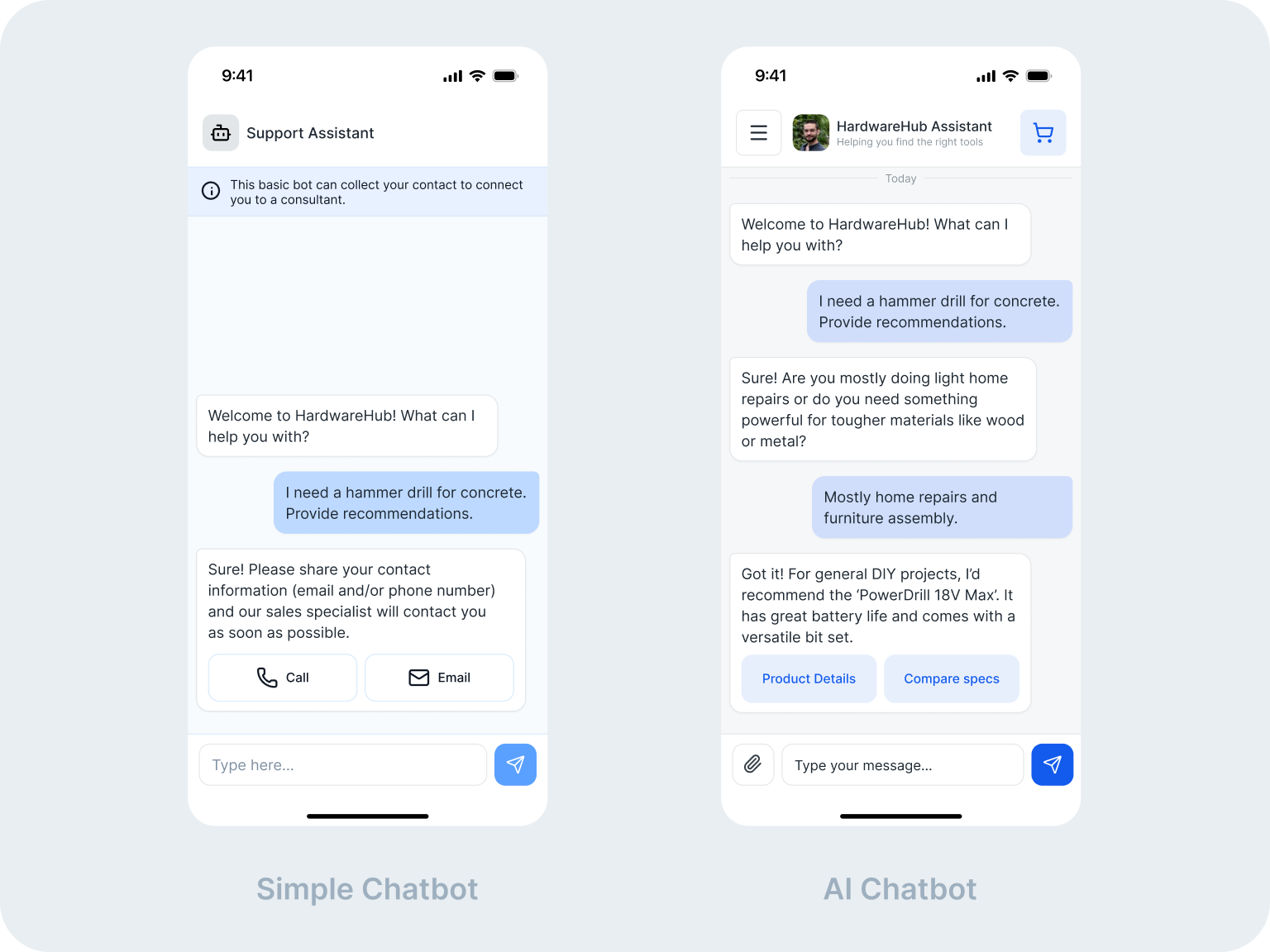
To address these challenges we developed a next-generation multifunctional AI assistant seamlessly integrated into the company’s digital ecosystem. The solution features adaptive logic, real-time data synchronization and modular APIs for CRM, ERP and product databases. At its core lies a fine-tuned LLM, ensuring brand-consistent communication and continuous learning from new products and interactions.
The solution was designed to replicate the behavior of a skilled sales consultant, providing customers with fast, accurate and personalized interactions through both chat and voice interfaces.
Key Capabilities include:
- End-to-End Automation. The AI assistant independently processes user requests, reducing the need for operator involvement. Routine inquiries and purchase consultations are handled autonomously within seconds.
- Enterprise-Grade LLM Adaptation. The core model was enriched with the company’s internal knowledge base, communication standards and sales scripts. It was fine-tuned using a large volume of historical interaction data to ensure consistent tone and alignment with brand guidelines.
- Personalized Product Guidance. Leveraging contextual data, the AI provides precise, personalized recommendations, presenting 2-3 curated product options based on user intent, complete with feature comparisons, availability and purchase links.
- Proactive Dialogue. The assistant maintains full conversational context across channels and proactively guides users toward target actions, such as adding items to the cart or completing a purchase.
- Voice Integration with Call Center Systems. The assistant is integrated into the call center infrastructure, allowing it to handle phone-based consultations autonomously while reducing agent workload.
- Post-Purchase Support. Customers receive ongoing assistance with warranty, returns, delivery tracking and accessory recommendations, ensuring full lifecycle engagement.
- Easy Plug-and-Play Integration. The solution easily integrates with existing enterprise systems including mobile apps, web e-commerce platforms and CRM tools, enabling fast deployment without disrupting existing workflows.
Let’s discuss your AI idea together!
The implementation followed a structured, phased approach designed to ensure technical reliability, linguistic precision and business alignment at every stage.
- Model Adaptation – Fine-tuning a general LLM with the company’s product data, communication standards and customer service scripts.
- Scenario Training – Implementing guided conversational flows for product selection, purchase assistance and after-sales support.
- System Integration – Embedding the assistant within the company’s web and voice infrastructure, linking it to CRM, catalog and logistics databases.
- Advanced Use Cases – Expanding integration with courier and voice systems, enabling operator collaboration and multi-agent workflows.
.png)
The deployment of the AI assistant fundamentally redefined how the company interacts with its customers, creating measurable improvements in efficiency, consistency, and user satisfaction.
- Response time for customer inquiries dropped from an average of 30 minutes to under 2 minutes, transforming the service experience into an instant conversational interaction. This acceleration directly translated into higher conversion rates, as customers received immediate tailored recommendations without waiting for a human operator.
- Operational efficiency also saw a significant leap. By automating up to 70% of first-line requests, the company reduced dependency on manual labor and achieved a scalable cost model, ensuring that growth in customer volume no longer correlates with increased staffing needs.
- Beyond measurable KPIs, the AI assistant reinforced brand reputation by positioning the company as a technological innovator. The new AI-driven communication model fostered a deeper sense of engagement, reliability and modernity, setting a new industry benchmark for digital customer experience in retail.
FAQ
Key Highlights
How did the AI assistant manage to reduce the average response time from 30 minutes to 2 minutes?
How does the AI assistant know which products to recommend to a customer?
How does the solution ensure brand-consistent communication without sounding robotic?
Can the assistant handle complex post-purchase cases, like warranty or returns?
How does the system integrate with our existing call center and CRM tools?
What measurable business impact did the company achieve after deployment?
Connect With Our AI Experts
Get a quote and find out more about your next AI solution
1
Sunmait experts contact you within 24h.
2
We discuss your project idea.
3
We sign an NDA for complete transparency.
4
We submit a comprehensive project proposal with estimates, timelines, etc.